How do you choose between a tiny house and an off-road trailer?
Tiny houses and off-road trailers serve very different purposes. Let’s take a look at the differences between the two.
What is a Tiny House?
A Tiny House is a unique small home with a metal or wooden frame, often mounted on a trailer. This type of dwelling offers a breath of fresh air and allows nature lovers and those seeking a complete escape to live wherever they choose.
A Tiny House is like a small house that you can live in and move from time to time, such as when you move to a new location.
Although it is smaller than a typical home, it has all the essential amenities needed for comfortable daily living: a kitchen, a bathroom, a bedroom, and a living room.
As a result, it can be adapted to suit a variety of user profiles:
- Individuals who wish to use it as their primary residence, a home extension, a unique event space, or a rental property…
- Professionals looking to grow their business without investing in physical space (such as healthcare providers, mobile vendors, etc.)
- Professionals in the rental industry—such as vacation rentals and campgrounds—who provide unique accommodations for tourists, thereby generating revenue.
- Investors who diversify their portfolios see a quick return on their investment.
If you’d like to learn more about this sustainable investment, please feel free to check out our section.
Some technical information about the Tiny House.
Since the Tiny House is mounted on two axles, in order to tow a trailer weighing more than 500 kg, the trailer must have a registration certificate.
The Tiny House can be self-sufficient by having its own wastewater system and solar panels.
This alternative housing is made from high-quality, eco-friendly materials.
What are the benefits of a tiny house?
Tiny House trailers can range from 6 to 8 meters in length, depending on your lifestyle needs. This makes them suitable for the whole family. Plus, you can customize them to suit your needs and preferences—you can add a bike rack, a luggage rack, and more…
The most notable advantage of tiny houses is still how easy they are to set up:
You can set it up on developed land or at campgrounds. Since the passage of the ALUR Law, depending on your city’s local urban planning regulations (PLU), it is possible to set up on non-buildable land and live there year-round if the site is designated as a “designated plot,” just like other lightweight dwellings (yurts, trailers, domes).
Since the Tiny House has no foundation and a floor area of less than 20 square meters, a building permit is not required. It is also exempt from property tax and housing tax.
What is an off-road camper?
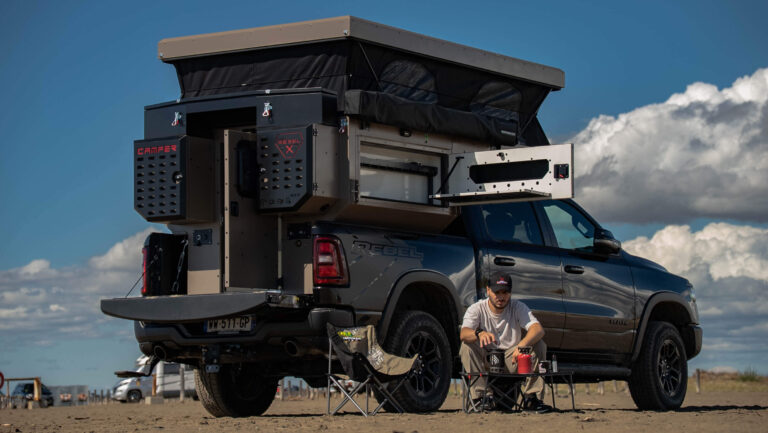
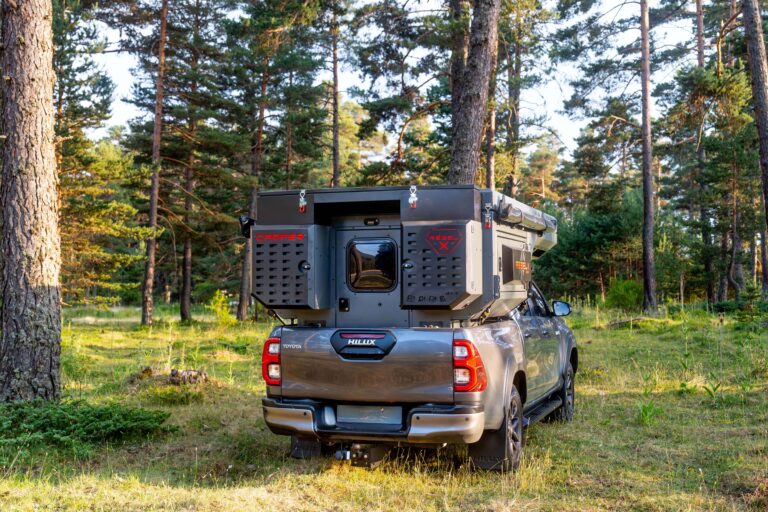
The Off-Road Caravan is an all-terrain caravan, often towed by all-terrain vehicles as well, designed for adventurers seeking new outdoor discoveries and thrills. This compact and comfortable design is suitable for even the steepest roads. Thanks to its various features, it offers better traction on roads, trails, and other terrain. Just like the Tiny House, if the gross vehicle weight rating exceeds 500 kg, the off-road caravan must be registered.
It ensures safety thanks to its braking system and spare tire, and offers a longer lifespan while maintaining the comfort of a traditional caravan.
What are the advantages of an off-road camper?
The off-road caravan can be used year-round, regardless of the weather, and allows you to explore places that are otherwise almost inaccessible when camping. The off-road caravan is accepted at campgrounds and all other lodging facilities, as well as at RV parks.
It is self-sufficient and features a water tank, allowing it to thrive in even the harshest environments, while its rugged chassis enables it to tackle all types of terrain. To maximize the off-road Caravane’s range, solar panels can be installed on the roof.
In conclusion, the tiny house and the off-road trailer serve two very distinct purposes.
Both the Tiny House and the off-road trailer are mobile homes, but they aren't suited to the same lifestyle or the same goals.